
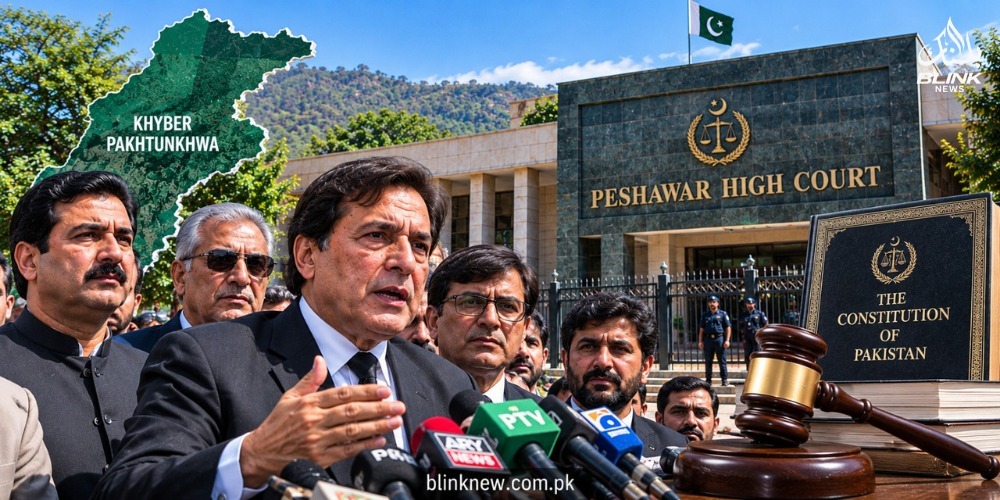
Tehreek Tahafuz Aain Pakistan has challenged the reported imposition of governor’s rule and an emergency in Khyber Pakhtunkhwa before the Peshawar High Court. The legal move brings the province’s political and constitutional situation into focus, with questions about provincial autonomy, government authority, and the constitutional limits on federal intervention.
The development is significant because governor’s rule can affect the functioning of an elected provincial government and the distribution of executive powers. By approaching the Peshawar High Court, the movement is seeking judicial scrutiny of the measures described in its petition.
The precise grounds of the petition, the respondents named in the case, and the court’s current proceedings should be confirmed through official court documents or statements from the parties. BlinkNews will continue to follow verified updates as more information becomes available.
KP Governor Rule Challenged in Peshawar High Court
The reported petition filed by Tehreek Tahafuz Aain Pakistan concerns the constitutional validity of governor’s rule and emergency measures in Khyber Pakhtunkhwa. The movement’s decision to approach the provincial high court places the dispute within the judicial process.
The Peshawar High Court has jurisdiction over a wide range of legal matters arising in the province. Depending on the nature of the petition and the relief requested, the court may examine questions involving constitutional provisions, the authority of public officials, and the legality of government action.
However, filing a petition does not automatically mean that the challenged measures have been suspended or declared unlawful. Any interim order, hearing date, or final decision must be established through the court’s official record.
Why the Legal Challenge Matters
Governor’s rule is a significant constitutional issue because it can change how a province is administered. Disputes over its use often raise questions about democratic representation, the authority of elected institutions, and the circumstances in which exceptional constitutional powers may be exercised.
The petition could therefore have implications beyond the immediate political disagreement. Its outcome may influence discussions about provincial autonomy and the legal safeguards governing relations between federal and provincial authorities.
What Does Governor’s Rule Mean in Pakistan?
Pakistan’s Constitution establishes a parliamentary system with responsibilities divided between federal and provincial institutions. It also provides specific procedures for exceptional circumstances, including situations in which constitutional governance may be affected.
Article 234 of the Constitution addresses a situation in which the constitutional machinery of a province cannot be carried on in accordance with the Constitution. It provides a framework for presidential action following the required constitutional process and on the basis of the relevant circumstances.
This process is not the same as an ordinary political disagreement between governments. The constitutional requirements and applicable procedures are central to determining whether extraordinary measures can lawfully be introduced.
Difference Between an Emergency and Governor’s Rule
An emergency and governor’s rule are related constitutional concepts, but they should not automatically be treated as identical. Their legal basis, conditions, consequences, and procedures depend on the applicable constitutional provisions.
The exact legal measures challenged in the Peshawar High Court are therefore important. The petition and any government notification would help establish whether the case concerns a formal constitutional proclamation, administrative arrangements, or another government action.
Readers should avoid assuming that every political announcement about an emergency means that all provincial powers have been transferred or that the provincial assembly has been dissolved.
Role of the Peshawar High Court
The Peshawar High Court may examine the legal arguments presented by the petitioners and the responses submitted by the relevant authorities. The scope of judicial review will depend on the petition, the applicable constitutional provisions, and the questions properly placed before the court.
The proceedings may involve several important issues:
- Whether the challenged action followed the required constitutional procedure.
- Whether the authorities had a valid legal basis for the measures.
- Whether the petitioners have established grounds for the relief they are seeking.
- Whether interim protection is justified while the case is being considered.
These are potential legal questions, not confirmed findings in this particular case. The court’s actual observations and orders will determine the direction of the proceedings.
A judicial challenge also provides an opportunity for the parties to present legal arguments through formal channels rather than relying exclusively on political statements.
Political Implications for Khyber Pakhtunkhwa
Khyber Pakhtunkhwa remains an important part of Pakistan’s political landscape. Relations between the federal government and provincial leadership can affect governance, public administration, development priorities, and the implementation of policies.
The reported challenge by Tehreek Tahafuz Aain Pakistan could add another dimension to these discussions. Political groups may view the dispute through the wider debate over democratic representation and provincial authority, while government officials may present their own legal or administrative justification if they respond to the petition.
Nevertheless, the legal position must be assessed separately from political reactions. The filing of a case does not, by itself, establish that the challenged action was unconstitutional or that the petitioners will succeed.
The court’s reasoning, documentary evidence, and the arguments of both sides will be essential to understanding the dispute.
What Happens Next in the Case?
The next steps will depend on the case’s procedural status and any directions issued by the Peshawar High Court. The court may consider whether notices should be issued to the respondents, request their responses, schedule further hearings, or address an application for interim relief.
The parties may also release statements explaining their positions. Official notifications, the petition’s available text, and court orders will be particularly useful for establishing the facts.
Until those details are confirmed, it would be premature to predict the outcome or claim that the court has already ruled against the governor’s rule or emergency measures.
BlinkNews will monitor developments involving the petition, the government’s response, and any subsequent judicial decisions.
Conclusion
The reported move by Tehreek Tahafuz Aain Pakistan to challenge governor’s rule and emergency measures in Khyber Pakhtunkhwa has brought constitutional governance and provincial autonomy into the spotlight.
The Peshawar High Court’s handling of the petition will be important in determining the legal questions raised by the dispute. The case also highlights the role of the judiciary in reviewing government action under Pakistan’s constitutional framework.
For now, the petition’s precise claims and the court’s orders remain essential to understanding the case fully. Follow BlinkNews for verified updates on Khyber Pakhtunkhwa politics, constitutional developments, and important court proceedings in Pakistan.