
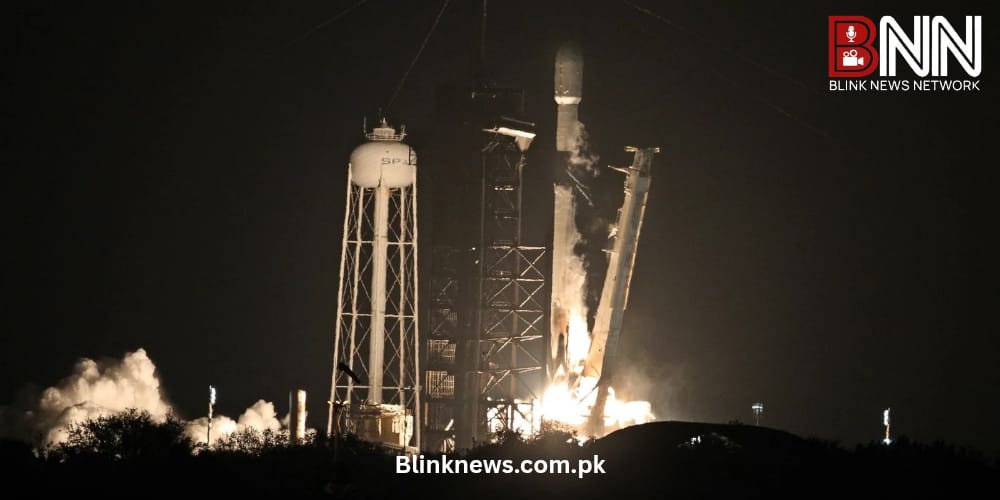
A SpaceX rocket is once again making headlines as reports surrounding a SpaceX rocket set for Moon collision on August 5 have captured the attention of the global space community. The unusual event has sparked renewed interest among astronomers, scientists, and space enthusiasts, who are closely monitoring the expected impact and its potential scientific significance.
According to experts, the rocket stage involved in the incident has been drifting through space for years after completing its original mission. Rather than returning to Earth, the abandoned booster remained in a chaotic orbit influenced by the gravitational forces of both Earth and the Moon. Consequently, scientists predicted that its trajectory would eventually lead to a collision with the lunar surface.
Although the event may sound alarming, researchers have emphasized that the impact poses no danger to people on Earth. Instead, it represents a rare opportunity to study how human-made objects interact with the Moon’s surface. Furthermore, the collision is expected to create a new crater, offering valuable information for future lunar research and exploration missions.
The discussion surrounding the SpaceX rocket set for Moon collision on August 5 has also reignited conversations about the growing amount of space debris orbiting beyond Earth. While thousands of satellites and rocket components have been launched into space over the decades, only a small number end up on trajectories that intersect with the Moon. Therefore, events like this remain extremely uncommon.
Meanwhile, scientists continue using powerful telescopes and orbital tracking systems to estimate the precise location and timing of the expected impact. However, because the collision is likely to occur on the far side of the Moon, it may not be directly visible from Earth. Even so, lunar orbiters could later capture images of the newly formed impact site, helping researchers analyze the crater and surrounding material.
In addition, the incident highlights the increasing importance of responsible space exploration. As governments and private companies expand missions to the Moon and beyond, experts argue that improved planning for spacecraft disposal will become increasingly essential. Proper end-of-mission strategies could reduce the number of uncontrolled objects traveling through deep space while supporting long-term sustainability.
SpaceX has not indicated that the collision will affect any current missions, and the event involves hardware that is no longer operational. Consequently, ongoing launches, satellite deployments, and lunar exploration efforts are expected to continue without interruption.
The anticipated impact also arrives during a period of renewed international interest in lunar exploration. Multiple space agencies and commercial organizations are preparing ambitious missions aimed at establishing a long-term human presence on the Moon. As a result, every opportunity to gather additional scientific data about the lunar surface is considered valuable.
Although the collision itself is expected to last only moments, its scientific importance could extend for years. Researchers hope that studying the resulting crater will improve understanding of lunar geology, impact mechanics, and the effects of artificial objects striking celestial bodies.
For now, attention remains focused on the SpaceX rocket set for Moon collision on August 5, a rare event that underscores both the achievements and the challenges of modern space exploration. As scientists await new observations following the impact, the incident serves as another reminder of humanity’s expanding presence beyond Earth and the ongoing responsibility to manage objects left behind in space.