
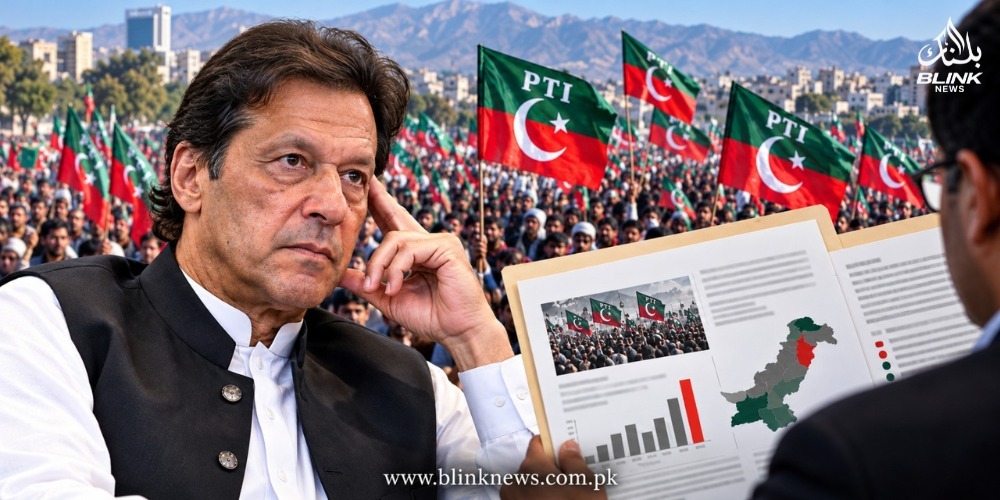
An intelligence report has reportedly highlighted a gap between Pakistan Tehreek-e-Insaf’s (PTI) confrontational political narrative and the public response observed on the ground. The reported assessment has brought renewed attention to political messaging, public sentiment, and the challenges of measuring support for political parties in Pakistan.
PTI has remained a prominent force in the country’s political landscape, with its leadership frequently addressing supporters on government policies, political disputes, and the party’s demands. However, the relationship between political statements and public participation is complex, and public reaction can vary across regions and communities.
The report’s specific findings, methodology, and evidence need to be confirmed through a credible source before its conclusions can be treated as established facts. BlinkNews will continue to follow verified developments concerning PTI and Pakistan’s political environment.
PTI Confrontational Narrative Under Discussion
The reported intelligence assessment focuses on the difference between PTI’s political messaging and the response attributed to people on the ground. This distinction matters because a party’s public statements do not always reflect the full range of opinions among voters and supporters.
Political narratives often seek to mobilise supporters, challenge opponents, and influence public debate. PTI’s messaging has frequently centred on its political grievances, demands for accountability, and criticism of government decisions.
The reported assessment appears to raise questions about whether the intensity of political messaging translates into an equivalent level of public participation or support. However, without access to the original report, it would be premature to conclude that PTI’s public backing has declined or that the assessment represents the views of the wider population.
Why Political Narratives and Public Reactions Can Differ
Political communication and public opinion do not always move together. A statement that attracts significant attention online may not necessarily lead to large public gatherings, electoral gains, or sustained participation in political activities.
Social Media Reach Is Not the Same as Public Support
Social media platforms allow political parties to distribute messages quickly and reach audiences across Pakistan and abroad. Online engagement can help parties communicate with supporters, respond to criticism, and shape national conversations.
However, views, shares, comments, and online trends do not provide a complete picture of public opinion. Some users may engage with political content without supporting the party, while others may support a party without regularly participating online.
To understand political support accurately, researchers generally examine several indicators, including credible opinion surveys, election results, turnout figures, local reporting, and participation in public events.
Regional Differences Matter
Pakistan’s political landscape varies considerably by province, district, and community. Economic conditions, local leadership, security concerns, and access to public services can influence how people respond to political messages.
PTI’s support and political priorities may therefore differ between urban centres, rural communities, and different regions. A single observation or assessment cannot automatically represent the views of all voters.
A reliable understanding of the public response requires evidence collected across different locations and demographic groups.
What an Intelligence Assessment Can and Cannot Establish
Intelligence assessments can examine political developments, public mobilisation, security concerns, and possible risks. Their value depends on the quality of the information available, the methods used to interpret it, and the scope of the assessment.
An intelligence report may provide a particular institutional perspective, but its conclusions should not automatically be treated as a comprehensive measure of public opinion.
For the reported findings about PTI, several questions remain important:
- What specific evidence does the report present?
- Which regions or public events does it examine?
- Does it rely on verified observations, surveys, or other forms of information?
- Does it distinguish between online engagement and participation in physical events?
- Has the report been independently corroborated?
Answers to these questions would help readers determine how much weight to give the reported conclusions.
Implications for PTI’s Political Strategy
If a verified assessment identifies a difference between political messaging and public participation, PTI and other political parties may need to consider how effectively their messages address voters’ concerns.
Connecting Political Messages With Everyday Issues
Public opinion is often shaped by practical matters such as inflation, employment, healthcare, education, security, and the quality of government services. Political messaging that addresses these issues with clear proposals can help voters assess a party’s priorities.
For PTI, as for other parties, public engagement involves more than communicating criticism of political opponents. It also includes explaining policy positions, responding to local concerns, and maintaining communication with communities outside major political events.
Measuring Support Through Reliable Evidence
Political strength is difficult to measure using a single indicator. Election results, independently conducted surveys, public participation, and local political reporting can each offer useful information, although every method has limitations.
If the reported intelligence assessment is made public, comparing its claims with independently verifiable evidence would provide a clearer picture of the political situation.
Until then, claims about the scale of PTI’s public support should be approached cautiously.
Wider Impact on Pakistan’s Political Environment
The relationship between political narratives and public response matters for Pakistan’s wider democratic process. Political parties depend on public trust, credible communication, and their ability to represent the concerns of voters.
Strong political disagreements can attract attention, but lasting political influence also depends on organisation, public engagement, policy proposals, and electoral participation.
The reported assessment may contribute to discussion about how political parties measure their reach and understand changing public sentiment. Its broader significance, however, will depend on the evidence behind its conclusions and whether independent information supports them.
Readers should distinguish between verified developments and interpretations attributed to unnamed sources. This is particularly important when intelligence-related claims concern politically sensitive subjects.
Conclusion
The reported intelligence assessment highlighting a gap between PTI’s confrontational narrative and the public response on the ground raises questions about political communication and the measurement of public support in Pakistan.
Nevertheless, the report’s findings cannot be independently evaluated without details about its evidence, scope, and methodology. Online attention, political speeches, and individual observations alone cannot establish the overall level of public support for a party.
A clearer assessment will require verified reporting and reliable indicators of public opinion. BlinkNews will continue to cover significant political developments involving PTI and other parties as credible information becomes available.