
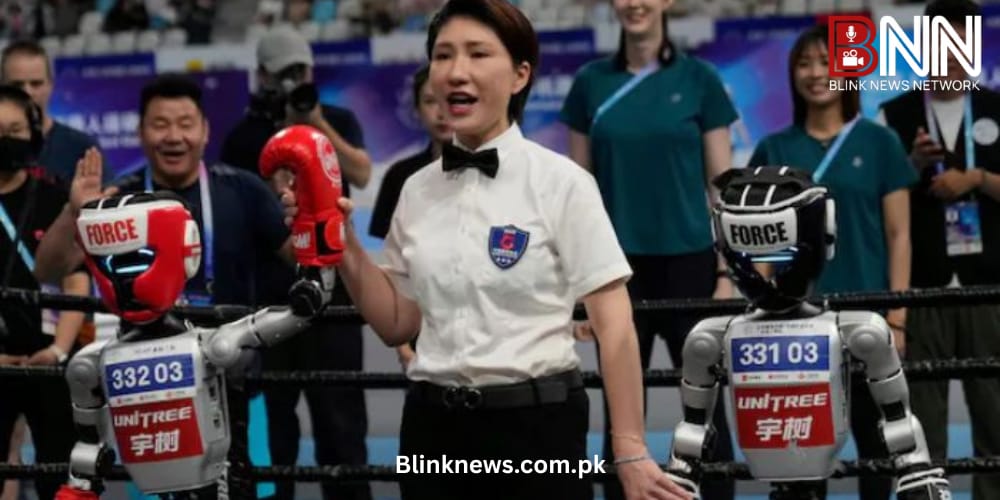
Humanoid robots have broken new records at the Beijing Robot Games, highlighting the rapid advances being made in robotics and artificial intelligence.
The event brought together humanoid machines to compete in a range of challenges designed to test their mobility, balance, coordination and ability to perform tasks in environments modeled on human activities.
Several robots demonstrated improved performance compared with previous competitions, reflecting advances in robotic hardware, sensors, control systems and AI-powered decision-making. Their ability to walk, run and complete physical tasks has become a major focus for developers seeking to create machines capable of operating alongside people.
The Beijing competition also showcased China’s growing role in humanoid robotics. Technology companies and research teams are investing heavily in the development of robots designed for industrial, commercial and potentially household applications.
Experts say competitions such as the Beijing Robot Games provide an important testing ground for emerging technologies. By placing robots in challenging real-world scenarios, developers can identify weaknesses and improve their systems before wider commercial deployment.
The progress comes as the global robotics industry races to develop increasingly capable humanoids. Companies are working on robots that could eventually assist in factories, warehouses, healthcare, logistics and other sectors where repetitive or physically demanding work is required.
The record-breaking performances at the Beijing event underline how quickly the technology is evolving. However, significant challenges remain, including battery life, reliability, safety, cost and the ability of robots to operate consistently outside controlled environments.
As competition in humanoid robotics intensifies, events such as the Beijing Robot Games are expected to provide a glimpse of how machines could perform in the real world in the years ahead.