
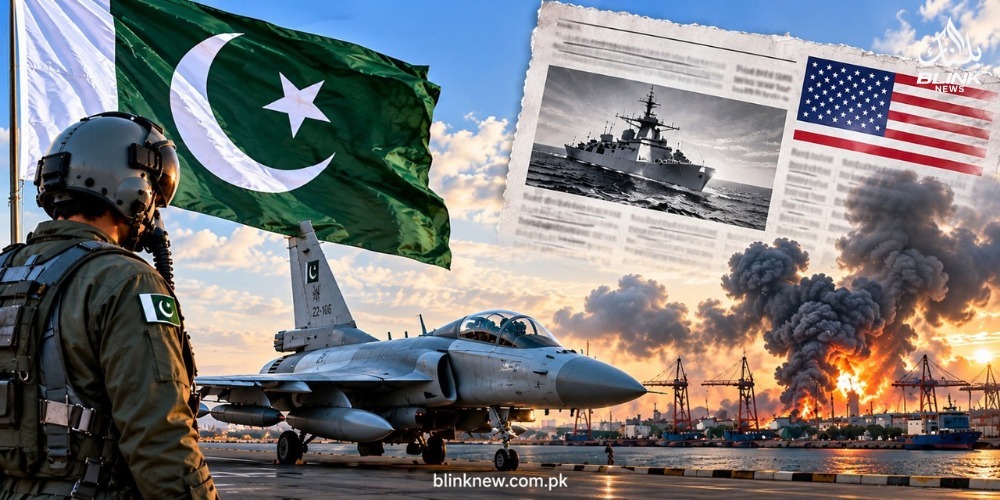
Pakistan has rejected a US media report claiming that the Pakistan Air Force (PAF) carried out action against Yemen’s Houthi movement, describing the report as false and fabricated. The denial has brought attention to the importance of accurate reporting on military affairs and Pakistan’s position on regional security developments.
The report concerns the Houthis, a movement based in Yemen that has been involved in regional tensions and attacks affecting shipping routes in the Red Sea. Any claim involving Pakistan’s armed forces and the group can attract international attention because of the potential implications for regional diplomacy and security.
Pakistan’s rejection challenges the claims presented in the report. However, the precise details of the original publication, including its source and supporting evidence, should be examined before drawing further conclusions.
Pakistan Rejects US Media Report on PAF Operations
Pakistan has strongly rejected the reported claim that its air force conducted an operation against the Houthis. The description of the report as false and fabricated signals a clear objection to the allegation.
Military-related reports require careful verification because inaccurate information can create confusion about a country’s defence policy, operational activities and international commitments.
The Pakistan Air Force is a central component of the country’s defence structure. Claims about its involvement in military action outside Pakistan can therefore have diplomatic consequences, particularly when they concern an active regional conflict.
Pakistan’s denial puts the focus on the difference between verified military developments and allegations circulating in the media.
Why the Report Has Attracted Attention
The allegation involves three important subjects: Pakistan’s military, US media coverage and the Houthi movement in Yemen.
Pakistan has its own national security priorities and foreign policy interests. Any suggestion that its armed forces have participated in operations against a regional group could prompt questions about the country’s strategic decisions.
At the same time, a media report should not be treated as confirmation of military involvement unless reliable evidence supports the claim.
What Is the Houthi Movement?
The Houthis, also known as Ansar Allah, are an armed political and religious movement that emerged in Yemen. The group has played a major role in the country’s prolonged conflict and controls significant territory, including the capital, Sanaa.
The movement has also become a central factor in regional security discussions because of attacks on commercial vessels and other activities affecting maritime traffic in and around the Red Sea.
These developments have drawn international attention, particularly from countries concerned about the safety of commercial shipping and access to important global trade routes.
Why the Red Sea Matters
The Red Sea connects with the Gulf of Aden through the Bab el-Mandeb Strait, a strategically important maritime passage. Ships travelling through this route serve markets in Europe, Asia, the Middle East and beyond.
Disruptions can increase shipping costs, force vessels to take longer routes and create uncertainty for international businesses.
Because of these risks, reports about military action involving the Houthis often receive widespread coverage. However, the regional importance of the issue does not establish that Pakistan participated in any particular operation.
Pakistan’s Position and Regional Security
Pakistan’s rejection of the report highlights the importance of distinguishing between confirmed military action and claims that have not been independently verified.
Military allegations can influence public opinion, diplomatic discussions and perceptions of a country’s foreign policy. For this reason, official clarifications are important when reports raise questions about the involvement of national armed forces.
Pakistan’s response should be considered alongside any available official statements, the original report and independently verified evidence. Without those details, it would be premature to make additional claims about the circumstances surrounding the allegation.
The Importance of Reliable Sources
Readers following this story should look for statements from relevant Pakistani authorities and compare them with the original US media report.
Several questions remain important when assessing such claims:
- What evidence did the original report provide?
- Did it cite named officials or anonymous sources?
- Has the publication issued a clarification or correction?
- Are there independent sources confirming the alleged operation?
- Have Pakistani authorities provided further details about their rejection?
These questions can help readers separate documented facts from speculation.
How the Dispute Could Affect Media Coverage
The dispute also highlights the challenges of reporting on defence and security issues. Information about military operations may be incomplete, sensitive or difficult to verify independently.
In a fast-moving news environment, an allegation can spread rapidly through websites and social media before all relevant facts become available. Repeating unverified claims without context can mislead readers and create unnecessary concern.
News organisations therefore have a responsibility to distinguish clearly between allegations, official denials and independently confirmed information.
For readers in Pakistan and abroad, the most useful approach is to assess the evidence rather than rely solely on headlines.
What Happens Next?
Further clarification from Pakistani authorities or the US publication could help establish how the allegation originated and whether additional evidence exists.
If the publication provides supporting documentation, it can be assessed alongside Pakistan’s response. If a correction or clarification is issued, that development would also be relevant to understanding the dispute.
For now, the central point is that Pakistan has rejected the report as false and fabricated. The allegation should not be presented as an established fact without credible supporting evidence.
BlinkNews will continue to follow developments related to Pakistan’s defence policy, regional security and official responses to international media reports.
Conclusion
Pakistan’s rejection of the US media report concerning alleged PAF action against the Houthis has placed renewed attention on military reporting and regional security. The claim involves sensitive questions about Pakistan’s armed forces and the wider situation in Yemen.
Although the report has generated interest, its allegations must be distinguished from verified facts. Further evidence, official statements and any clarification from the original publication will be important in assessing the matter.
For readers following Pakistan’s foreign policy and defence developments, relying on credible sources remains essential to understanding this story accurately.