
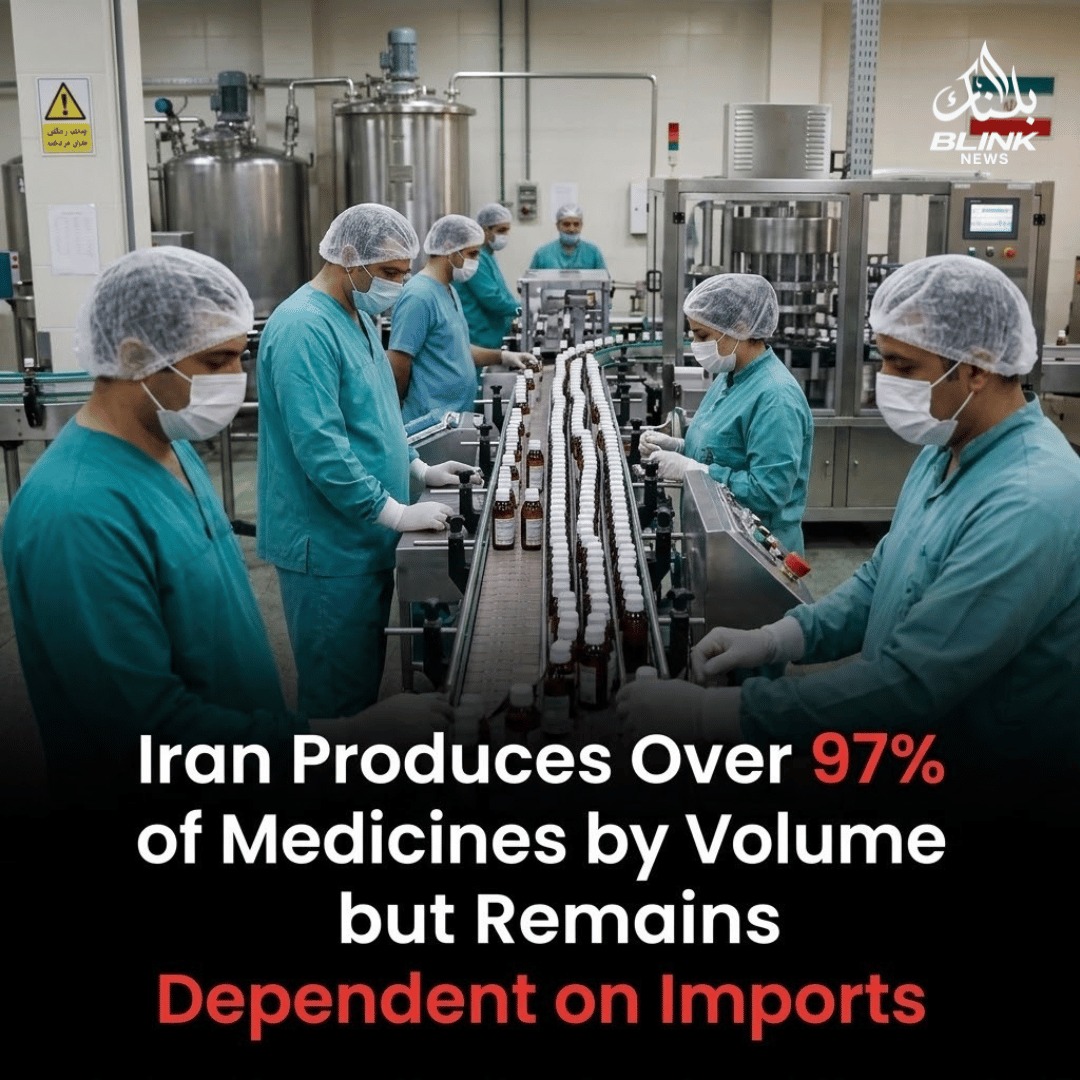
Iran’s pharmaceutical industry Iran Produces Over 97% of Medicines used in the country by volume, highlighting the scale of its domestic drug-manufacturing capacity. However, high local production does not mean complete pharmaceutical independence. Iran continues to rely on imported raw materials, active pharmaceutical ingredients (APIs), specialized medicines and equipment.
Recent figures show why the distinction between the number of medicines produced domestically and the value of pharmaceutical imports is important. The World Health Organization (WHO) reported that domestic producers supplied 98.5% of Iran’s pharmaceutical market by volume in 2021, while accounting for 87% of the market by value.
Iran’s Domestic Medicine Production Exceeds 97%
Iran has spent decades expanding its pharmaceutical manufacturing sector and reducing dependence on imported finished medicines. According to figures reported by Iranian officials, domestic producers now supply roughly 97% to 99% of medicines by number or volume, depending on the measurement and reporting period.
More recent Iranian reporting cited a figure of 98.87% for domestically produced medicines by quantity, with imported medicines accounting for about 1.13% of the market by number. However, imported products represented a substantially larger share of the market when measured by monetary value.
This difference is significant because imported medicines tend to include expensive and highly specialized products, meaning a relatively small number of imported drugs can represent a much larger share of pharmaceutical spending.
Why Medicine Volume Does Not Tell the Whole Story
A country can manufacture almost all commonly used tablets, capsules and other medicines domestically while still importing products that are expensive or difficult to manufacture locally.
Iran’s pharmaceutical market demonstrates this clearly. WHO data found that domestic production accounted for 98.5% of pharmaceutical market volume but 87% of market value in 2021.
This means that imported medicines make up a small portion of total volume but have a disproportionately higher financial value.
Iran Still Depends on Imported Pharmaceutical Inputs
The biggest challenge to Iran’s pharmaceutical self-sufficiency is not necessarily the production of finished medicines. Instead, manufacturers can remain dependent on international supply chains for raw materials and other essential inputs.
Active pharmaceutical ingredients, commonly known as APIs, are the substances responsible for the therapeutic effects of medicines. Iranian pharmaceutical companies produce a significant portion of these ingredients domestically, but studies have documented continued reliance on imports for some APIs and raw materials. Suppliers in countries including India and China have played a role in meeting these requirements.
Human Rights Watch previously reported that around one-third of medicines produced in Iran depended on imported materials, despite domestic production accounting for about 97% of medicines consumed at the time.
This creates a potential vulnerability: even when a medicine is manufactured inside Iran, disruptions to imported ingredients, machinery, foreign currency payments or transportation can affect domestic production.
Sanctions Add Pressure to Iran’s Pharmaceutical Supply Chain
International sanctions have complicated Iran’s access to foreign financial and logistics networks. Although humanitarian goods such as medicines may be formally exempt from certain sanctions, pharmaceutical companies can still face practical difficulties in obtaining ingredients, equipment and specialized treatments.
Recent reporting has highlighted continuing medicine shortages and supply-chain pressures in Iran, with the pharmaceutical sector still relying on imports for some critical ingredients, equipment and rare medicines.
The issue becomes particularly important for patients requiring specialized treatments, including medicines for rare diseases and certain forms of cancer. Earlier research found that imported medicines represented only a small share of Iran’s pharmaceutical market by volume but a much larger share of its value.
Specialized and High-Value Medicines Remain a Challenge
Domestic production is strongest in generic medicines and widely used pharmaceutical products. More complex or high-value treatments can be harder to manufacture locally because they require advanced technology, specialized ingredients, sophisticated equipment and significant research and development investment.
As a result, Iran’s pharmaceutical policy has focused not only on increasing finished-drug production but also on expanding domestic production of APIs and strengthening the wider pharmaceutical supply chain.
What the Latest Figures Mean for Iran
The latest data suggest that Iran has achieved a high degree of domestic pharmaceutical production, particularly when measured by volume. However, the figures should not be interpreted as complete independence from international pharmaceutical supply chains.
The difference between volume and value is especially important. Recent Iranian data cited by Tasnim put domestic production at 98.87% of the market by quantity, while imported medicines accounted for 13.86% of market value.
Therefore, even a relatively small number of imported medicines can have a significant effect on pharmaceutical spending and foreign-currency requirements.
Conclusion
Iran produces more than 97% of its medicines domestically by volume, reflecting decades of investment in its pharmaceutical manufacturing industry. WHO data and recent Iranian figures both show that domestic producers supply the overwhelming majority of medicines consumed in the country.
However, pharmaceutical self-sufficiency is more complicated than simply counting finished medicines. Iran continues to depend on imported raw materials, APIs, specialized medicines and equipment. Sanctions, currency restrictions and logistical disruptions can therefore affect domestic drug production even when most finished medicines are manufactured inside the country.
For Iran, the next challenge is not simply producing more medicines, but strengthening the entire pharmaceutical supply chain so that domestic manufacturers can reduce their dependence on critical imported inputs.
Frequently Asked Questions
1. Does Iran produce more than 97% of its medicines?
Yes. Available figures indicate that domestic producers supply more than 97% of medicines by volume or quantity. WHO reported that domestic producers supplied 98.5% of Iran’s pharmaceutical market volume in 2021.
2. Why does Iran still import medicines if it produces most of them?
Iran imports certain specialized, high-value and difficult-to-manufacture medicines. It also imports some pharmaceutical raw materials, APIs and equipment needed by domestic manufacturers.
3. What are active pharmaceutical ingredients?
Active pharmaceutical ingredients, or APIs, are the substances in medicines that produce their intended therapeutic effect. Pharmaceutical manufacturers may import some APIs even when the finished medicine is produced domestically.
4. Do sanctions affect Iran’s medicine supply?
Sanctions and related financial and logistical restrictions can make it more difficult for Iranian companies to obtain imported ingredients, equipment and specialized medicines. Research has documented the impact of such restrictions on pharmaceutical supply chains.
5. Does producing 97% of medicines mean Iran is completely self-sufficient?
No. The 97% figure primarily describes domestic production by quantity or volume. Iran can still remain dependent on foreign suppliers for some raw materials, APIs, specialized medicines and pharmaceutical equipment.